


Pet Insurance Regulation Is Finally Here: 16+ States Now Protect Consumers
February 2026 Guide
Meta Description: 16+ states adopted NAIC pet insurance protections in 2026. Learn how Florida HB 655 and new laws shift the burden of proof, cap waiting periods, and protect renewals. Compare top providers with AI claims and direct vet pay.
For years, the U.S. pet insurance market was often described as the “Wild West”—a landscape of confusing exclusions, hidden waiting periods, and heartbreaking claim denials. But as of February 2026, the tide has turned.
Driven by the National Association of Insurance Commissioners (NAIC) Pet Insurance Model Act, a wave of regulation has swept across the country. Reaching over 7.03 million insured pets (NAPHIA 2026), these changes are reshaping the industry. Led by early adopters like California and bolstered by new legislation such as Florida HB 655 (effective Jan 1, 2026), these states have adopted strictly enforced consumer protections that standardize how policies are sold, how claims are paid, and—most importantly—how “pre-existing conditions” are defined.
If you live in one of these states, your coverage is safer than ever. If you don’t, you need to know which providers are voluntarily complying with these new high standards. This guide breaks down exactly what has changed, who covers you best, and how to navigate the 2026 market.
Is Your State on the List? (Updated February 10, 2026)
As of early 2026, the following states have adopted the NAIC’s comprehensive regulatory framework. These laws legally bind insurers to higher transparency and fairer claims handling.
States with NAIC Model Act Adoption:
West Coast: California, Washington, Oregon
Mountain/Pacific: Nevada, Colorado, Montana, Hawaii
South: Florida, Louisiana, Mississippi
Northeast: Maine, New Hampshire, Vermont, Rhode Island, Connecticut, Massachusetts, New York
Mid-Atlantic: Pennsylvania, New Jersey, Delaware, Maryland
Midwest: Illinois, Ohio, Nebraska
Note: State lists vary as legislation passes. Check [state].gov/insurance for the latest status. Even if you live outside these states, many top-tier insurers (listed below) have rolled out these “Gold Standard” compliance measures nationwide to streamline their operations.
The 5 “Game-Changer” Regulations
Here is how the new laws fundamentally alter the policy you buy.
1. The End of “Pre-Existing” Ambiguity
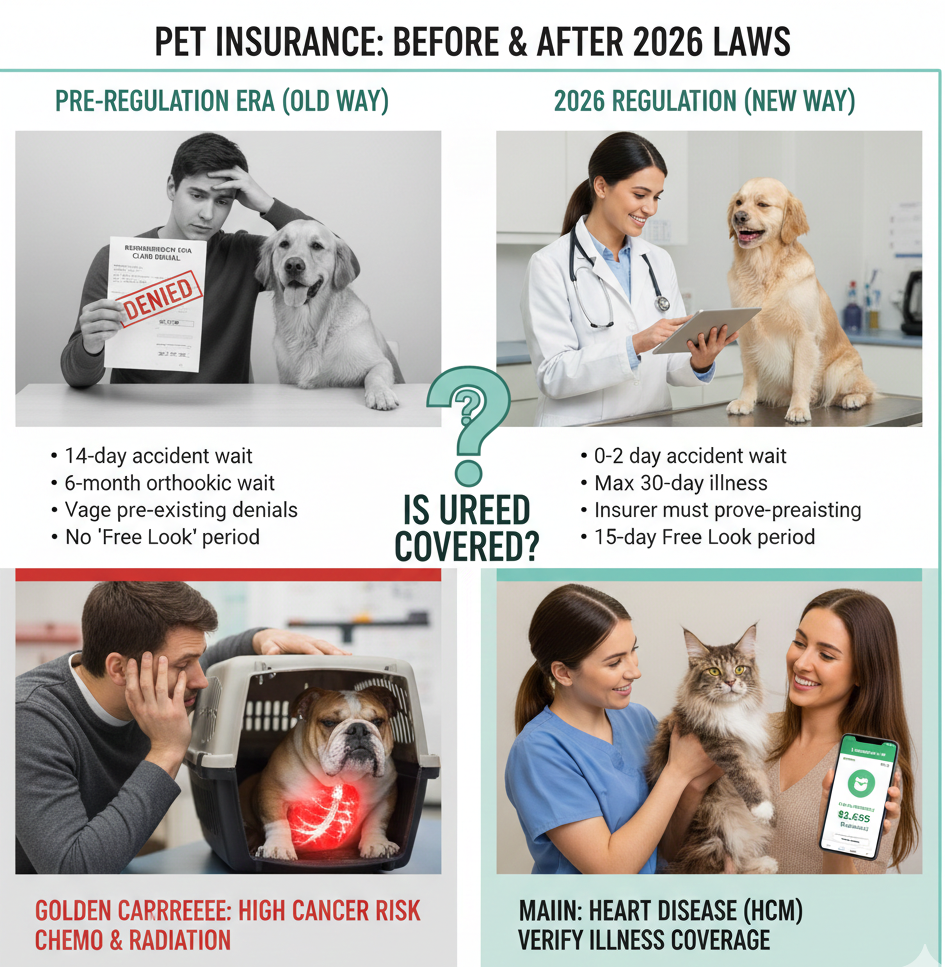
The Old Way: Insurers could vaguely define pre-existing conditions. If your dog limped once three years ago, a new ACL tear could be denied as “pre-existing,” even without a diagnosis.
The New Law: The burden of proof is now on the insurer. They cannot deny a claim based on a pre-existing condition unless there is clear medical evidence in the record. Furthermore, conditions can no longer be cited as pre-existing upon renewal.
2. Waiting Period Caps
The Old Way: Some policies had 30-day waiting periods for accidents or 6-12 months for orthopedic conditions (like Cruciate Ligament issues).
The New Law:
Accidents: Typically 0-2 days (varies by state). For example, California enforces 0 days, while Florida caps it at 2 days.
Illnesses: Maximum waiting period of 30 days.
Orthopedic: Special extended waiting periods (often 6 months) must now be disclosed in bold, large font at the point of sale, ensuring you aren’t blindsided.
3. Wellness vs. Insurance Separation
The Old Way: Insurers often marketed “Wellness Plans” (vaccines/grooming) as insurance, confusing buyers into thinking they had comprehensive medical coverage.
The New Law: Wellness programs must be sold and marketed separately. Insurers must explicitly state that wellness plans are not insurance products.
4. The “Free Look” Period
You now legally have a 15-day “Free Look” period (sometimes 30 days depending on the state). You can buy a policy, review the fine print, and cancel within this window for a 100% refund (provided no claims were filed).
5. Diagnosis Requirements
Insurers can no longer require a “pre-enrollment exam” to activate coverage unless they pay for it. If they don’t require an exam, they cannot later deny a claim by arguing the condition “must have existed” before coverage started.
Old World vs. New World: A Snapshot
| Feature | Pre-Regulation “Wild West” | 2026 Regulatory Standard |
| Renewal Terms | Premiums could spike, or conditions could be excluded after a claim. | “Guaranteed Renewable” – conditions cannot be re-classified as pre-existing. |
| Waiting Periods | Up to 14 days for accidents; 6+ months for knees. | 0-2 days for accidents (in most regulated states); max 30 days for illness. |
| Pre-Existing | Determined by insurer discretion/symptoms. | Determined by veterinary record; burden of proof on insurer. |
| Sales Tactics | Wellness and medical coverage blurred. | Strict separation of “Insurance” vs. “Non-Insurance” products. |
Real-World Cost & Claim Scenarios
To understand the financial impact, let’s look at three scenarios based on 2026 market data.
Scenario A: The “Pre-Existing” Dispute
Pet: “Luna,” 3-year-old Mixed Breed in Ohio (Regulated State).
Incident: Luna is diagnosed with hip dysplasia. She had a minor “stiffness” noted in a vet chart 2 years ago, but no diagnosis.
Outcome:
Without Regulation: Claim denied. The “stiffness” is used to classify the dysplasia as pre-existing. Out-of-pocket: $4,500.
With Regulation: Claim Approved. The insurer cannot prove that the stiffness was definitely hip dysplasia. The burden of proof protects Luna.
Payout: After a $250 deductible and 90% reimbursement, the insurance pays $3,825.
Scenario B: The Accident Waiting Period
Pet: “Cooper,” 5-month-old Lab Puppy in California.
Incident: Cooper swallows a sock 48 hours after the policy starts.
Outcome:
Old Policy: Denied. A 14-day accident waiting period was standard. Cost: $3,200 surgery.
New Policy: Approved. New laws prohibit waiting periods for accidents (or cap them at midnight following enrollment).
Payout: Insurance pays $2,655 (after deductible/co-pay).
Scenario C: The Chronic Condition Renewal
Pet: “Bailey,” 7-year-old Golden Retriever in Florida.
Incident: Bailey is diagnosed with Diabetes, requiring lifetime insulin and monitoring ($200/month).
Outcome:
Old Policy: At renewal, the insurer might classify Diabetes as a “pre-existing” condition for the new policy year, excluding it from future coverage, or spike the premium by 50% specifically because of the claim.
New Policy: Guaranteed Renewable. The insurer must renew the policy. They cannot exclude the diabetes, nor can they raise Bailey’s specific premium based on his individual claim history (only overall class rate adjustments allowed).
Impact: Bailey stays covered for life. Savings: $2,400+ annually.
For details on what typical pet insurance policies cover and what they exclude, see our article on what pet insurance does and does not cover in the USA.
Top Recommended Providers (2026)
We evaluated providers based on their compliance with these new laws, their innovation, and their willingness to extend protections nationwide.
| Provider | Best For | Annual Deductible | Reimbursement | 2026 Verdict & Innovation |
| Lemonade | Tech-Savvy Owners | $100 – $500 | 70%, 80%, 90% | Top Pick. Processes 55% of claims instantly via AI. In 2025, they donated $2.1M in unclaimed premiums to animal charities like the ASPCA. |
| Spot | Pre-Existing Conditions | $100 – $1,000 | 70% – 90% | Best for Forgiveness. Uniquely covers “curable” pre-existing conditions if your pet has been symptom-free for 180 days. Ideal for allergies or ear infections. |
| Trupanion | Direct Vet Pay | $0 – $1,000 (Lifetime per condition) | 90% | Best for Cash Flow. Pays vets directly at checkout at 90% of participating clinics, eliminating the reimbursement wait entirely. |
| Healthy Paws | Cat Owners | $100 – $500 | 70% – 80% | Best Value. Consistently lower premiums for cats. No annual limits, which is a massive safety net for chronic conditions. |
Current Cost Analysis (February 2026)
With over 7.03 million insured pets in North America (NAPHIA 2026), the market has stabilized, though veterinary costs continue to rise.
Average Dog Monthly Premium: $35 – $68
Lowest: Mixed breeds, small dogs ($35-$45)
Highest: French Bulldogs, Bernese Mountain Dogs ($85-$120)
Average Cat Monthly Premium: $18 – $32
Lowest: DSH (Domestic Short Hair)
Highest: Maine Coon, Persian
Factors That Will Spike Your Rate:
Age: Premiums can double between ages 3 and 7.
Breed Risks: Insuring a French Bulldog will cost 2-3x more than a mixed breed due to respiratory and spinal risks.
Location: NY and CA premiums are roughly 30% higher than the national average due to vet labor costs.
Red Flags: What Regulation Hasn’t Fixed Yet
Even in regulated states, you must watch out for these pitfalls:
Bilateral Exclusions: If your dog tore a cruciate ligament in the left knee before coverage, the right knee is often excluded. Regulation has not fully banned this yet.
“Percentage” Co-Pay Traps: Some insurers now base reimbursement on “Usual and Customary Costs” rather than your actual vet bill. Always choose a plan that pays on “Actual Vet Bill.”
Caps on Chronic Conditions: Avoid any policy that places a “per-incident” limit (e.g., $2,000 max for cancer). Always aim for an Annual Limit of at least $10,000 or Unlimited.
Breed-Specific Considerations
Bulldogs / Pugs: Strict attention to Respiratory System coverage is needed. Ensure “soft palate resection” is not excluded.
German Shepherds: High risk for Hip Dysplasia. Enrolling after age 2 often results in permanent exclusion for hips. Enroll as a puppy.
Golden Retrievers: High cancer risk. Ensure your policy covers Chemotherapy and Radiation (some “accident & illness” basic plans skip this).
Maine Coon Cats: Prone to Hypertrophic Cardiomyopathy (Heart Disease). Verify heart conditions are covered as a standard illness.

FAQ
Q: If I live in a non-regulated state, is my policy unsafe?
A: Not necessarily. Major players like Lemonade and Trupanion tend to standardize their policies nationally for operational ease. However, read the “Waiting Period” section of your contract carefully—it may still be 14 days for accidents in your state.
Q: Does pet insurance cover vaccines now?
A: Only if you buy the separate “Wellness” add-on. The new laws strictly separate “Medical Insurance” (broken bones, cancer) from “Wellness” (shots, flea meds) to prevent misleading marketing.
Q: Can they drop me if my pet gets cancer?
A: No. In 2026, reputable insurers (and all insurers in the regulated states) cannot cancel your policy or refuse renewal because your pet developed a chronic condition.
If you’re new to pet insurance and want a simple breakdown of how it works, read our pet insurance explained for beginners in the USA (2026) guide.