

New Pet Insurance Laws 2026: Disclosure Requirements, Pre-Existing Conditions & Your Rights
For years, pet insurance was often referred to as the “Wild West” of the insurance industry. Confusing policy language, arbitrary waiting periods, and the dreaded “pre-existing condition” denial left many U.S. pet owners frustrated. However, as of February 2026, the landscape has shifted dramatically.
Driven by record-breaking enrollment—reaching over 7.03 million insured pets in North America (NAPHIA 2026 data)—state regulators have established a new standard for consumer protection. This “Transparency Revolution” is centered on the adoption of the NAIC Pet Insurance Model Act, which is now law in a growing number of states.
Quick Summary (2026):
In 2026, new U.S. pet insurance laws require clearer disclosures, stronger protections against unfair pre-existing condition denials, and better consumer rights—especially in 16 regulated states.
You can also read our breakdown of what pet insurance does and does not cover in the USA.
States Leading the 2026 Reform
As of February 2026, 16 states have officially adopted the NAIC Model Act or equivalent high-transparency statutes. If you live in one of these states, your insurer is now legally required to meet the strictest disclosure standards in the industry:
West Coast: California, Washington, Oregon
East Coast: New York, Maine, Connecticut, New Jersey, Maryland, Rhode Island, Vermont, Delaware, Massachusetts
Central/South: Florida, Illinois, Ohio, Louisiana, Nebraska, Pennsylvania
Pro Tip: If your state isn’t listed, visit your state’s Department of Insurance website and search for “pet insurance regulations” to see whether similar legislation is pending in your state’s legislature.
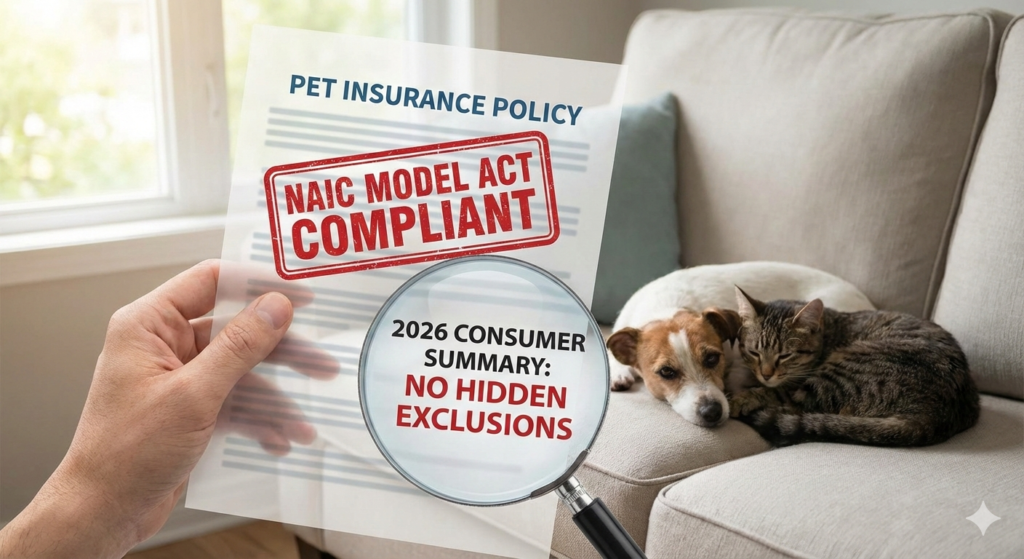
The most significant change in 2026 is the mandatory disclosure requirement. Insurers can no longer bury critical exclusions in the fine print. Under the new laws, providers must provide a clear “Consumer Summary” that highlights:
The 30-Day “Right to Examine”: You now have a 30-day “free look” period. If you haven’t filed a claim, you can cancel within the first month for a full refund—no questions asked.
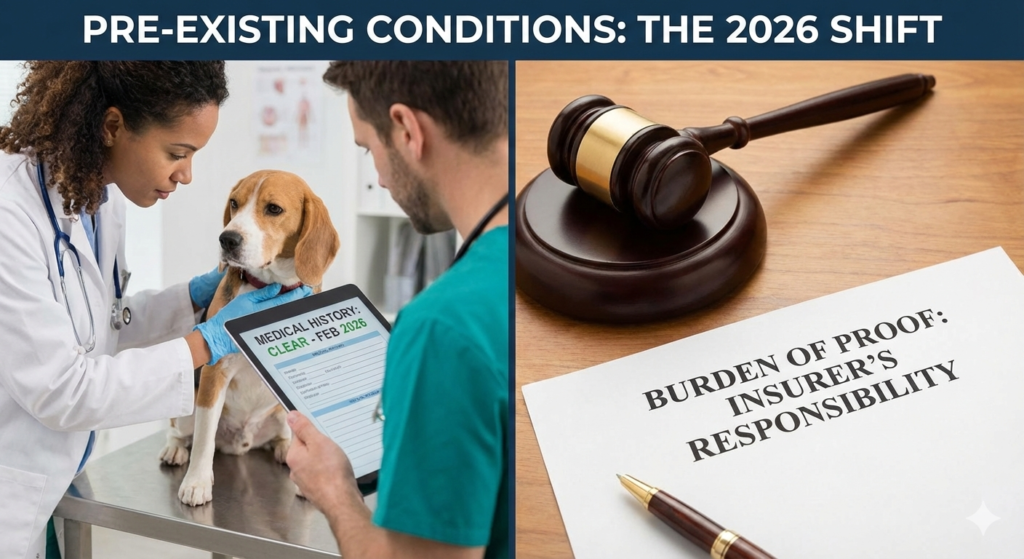
The Burden of Proof Shift: Historically, you had to prove a condition wasn’t pre-existing. Under Florida HB 655 (2026) and similar laws, the insurer must now provide clear medical evidence to justify a denial.
Wellness Transparency: Companies must explicitly state that “Wellness” plans are not insurance but service contracts. This prevents owners from confusing routine care with catastrophic illness coverage.
2. Comparing the Top 2026 Providers
The 2026 market has forced providers to innovate. Below is a comparison of the five top-rated companies based on their compliance with new transparency laws and their value for pet owners.
2026 Pet Insurance Comparison Table
| Provider | Best For | Avg. Monthly (Dog/Cat) | Waiting Periods | 2026 Legal Innovation |
| AKC Pet Insurance | Pre-existing Conditions | $48 / $26 | 2d (Acc) / 14d (Ill) | Full Pre-Existing Coverage after 365 days of continuous enrollment. |
| Lemonade | Fast Claims (AI) | $35 / $18 | 2d (Acc) / 14d (Ill) | Instant AI Claims: ~55% of claims processed in seconds with zero paperwork. |
| Spot | Customization | $42 / $22 | 14d (All) | Curable Conditions: Covers pre-existing issues if symptom-free for 180 days. |
| Trupanion | Vet Direct Pay | $62 / $34 | 0d (Acc) / 30d (Ill) | Zero-Reimbursement Model: Pays the vet directly at the time of checkout. |
| Embrace | Shrinking Deductible | $45 / $24 | 2d (Acc) / 14d (Ill) | Healthy Pet Bonus: Deductible drops by $50 for every year you don’t claim. |
3. Deeper Look: 2026 Provider Innovations
AKC Pet Insurance: The Pre-Existing Breakthrough
In 2026, AKC Pet Insurance remains the only major carrier to offer a pathway to coverage for incurable pre-existing conditions. After 365 days of continuous coverage, AKC may reclassify a pre-existing condition (like chronic allergies, diabetes, or even heart disease) as a covered illness. This is revolutionary for owners who previously felt “trapped” with a provider because their pet had developed a chronic condition.
Lemonade: The “Giveback” & AI Payouts
Lemonade has disrupted the industry by aligning its interests with the customer. Their “Giveback” model takes a flat fee for operations; then, at the end of the year, unclaimed premium money is donated to animal charities chosen by policyholders. In 2025, Lemonade donated over $2.1 million to organizations like the ASPCA. Furthermore, their AI-driven system now handles simple vet bills in seconds, often depositing funds into your bank account before you’ve even left the clinic parking lot.
4. Real-World Claim Scenarios (2026 Costs)
Veterinary costs have surged nearly 60% in urban centers over the last decade. Here is how insurance handles the bill in 2026.
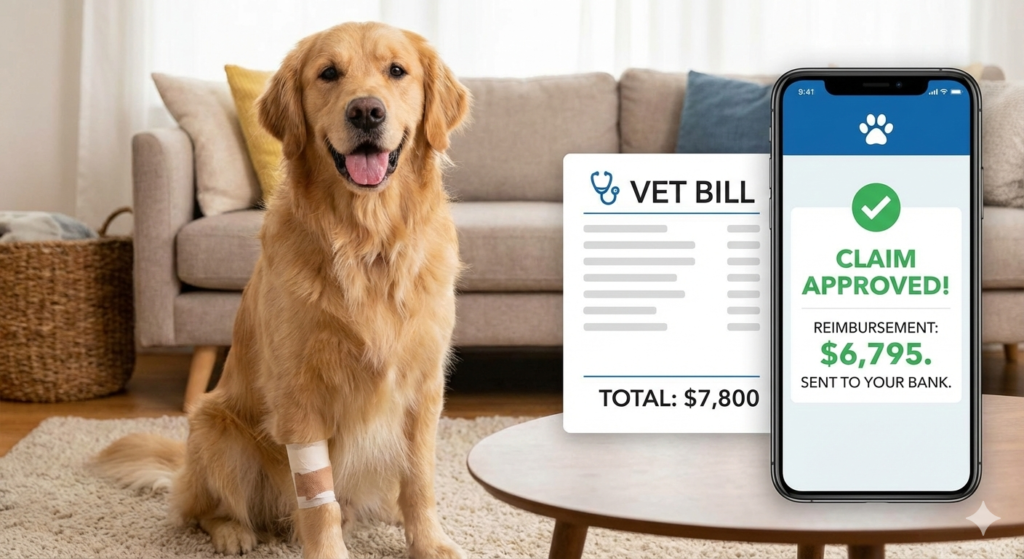
Scenario A: The Cranial Cruciate Ligament (CCL) Tear
Pet: 4-year-old Golden Retriever (High-risk breed)
Total Vet Bill (Surgery + Rehab): $7,800
Policy: 90% Reimbursement / $250 Deductible
The Math: $7,800 – $250 deductible = $7,550. 90% of $7,550 = $6,795 (Paid by Insurer).
Your Out-of-Pocket: $1,005
Scenario B: Feline Urinary Blockage
Pet: 2-year-old Indoor Cat
Total Vet Bill (Emergency Hospitalization): $4,200
Policy: 80% Reimbursement / $500 Deductible
The Math: $4,200 – $500 = $3,700. 80% of $3,700 = $2,960 (Paid by Insurer).
Your Out-of-Pocket: $1,240
5. Breed-Specific Risks in 2026
The new laws require insurers to be more transparent about “breed-specific” exclusions. When shopping, keep these high-risk conditions in mind:
French Bulldogs: Look for plans covering Brachycephalic Syndrome. 2026 laws prevent insurers from excluding this as “pre-existing” if it was not medically diagnosed during the puppy exam.
German Shepherds: Prioritize Hip Dysplasia coverage. Ensure the waiting period (typically 6 months) can be waived with a vet exam.
Maine Coon Cats: Focus on Hypertrophic Cardiomyopathy (HCM). Since this is hereditary, confirm your policy includes hereditary/congenital conditions as standard, not as a paid rider.
6. Red Flags & Consumer Protections
Watch out for these “Old School” tactics that the 2026 laws aim to eliminate:
Bilateral Condition Traps: If your dog has a knee injury on the left side before coverage, some insurers will exclude the right side forever. Look for policies that explicitly state they do not use bilateral exclusions.
The “Renewal Exam” Requirement: Some older policies required a new physical exam every year to keep coverage active. This is now prohibited in states that have adopted the NAIC Model Act.
Vague “Clinical Signs”: If your cat sneezed once in 2023, an unethical insurer might try to deny an upper respiratory claim in 2026. The new laws require the insurer to prove a direct clinical link.
7. Alternatives to Insurance
If your pet is a senior or has severe pre-existing conditions that even AKC won’t cover, consider:
Pet Savings Account (PSA): Setting aside $125/month (the 2026 average cost of a premium policy + deductible portion).
PetAssure: A discount program (not insurance) that provides a flat 25% discount at participating vets with no exclusions.
Scratchpay/CareCredit: Low-interest financing specifically for veterinary emergencies.
8. FAQ Section
Q: Do the new laws apply to my current policy?
A: Yes, in “Model Act” states, these protections typically kick in during your 2026 policy renewal.
Q: Can a company raise my rates if I file a claim?
A: Most reputable 2026 providers use “community rating,” meaning rates are based on your pet’s age and breed in your area, not your individual claim history.
Q: Is dental coverage standard?
A: Dental illness (abscesses) is usually covered, but dental cleaning is almost always an optional “Wellness” add-on.
Q: What is the average 2026 cost for a dog?
A: For a mid-sized mixed breed, expect to pay $45–$65 per month for comprehensive accident and illness coverage.
Q: Does pet insurance cover “telehealth”?
A: Yes, in 2026, most top-tier plans (Lemonade, Spot) include 24/7 “Vet Helpline” access at no extra cost.
how these new laws affect pricing, see our guide on average pet insurance cost per month in the USA.